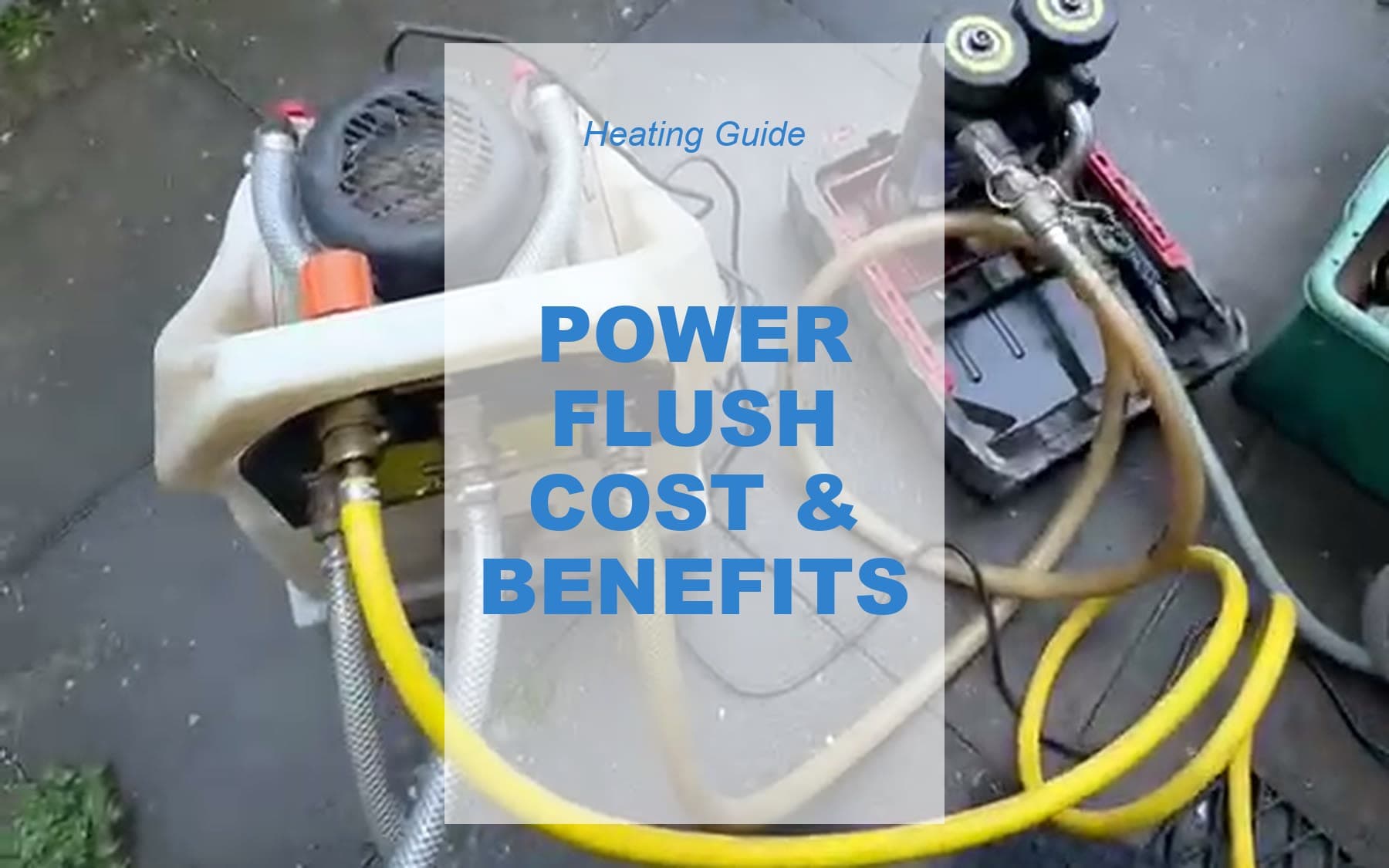
Power flush cost, how long it takes, and what actually happens
A central heating power flush restores heat, protects the boiler, and stops radiators clogging up with sludge. If your radiators are slow to warm, if there are cold spots, if the boiler keeps switching on and off, or if you are about to have a new boiler fitted, this is the job you are looking at.
Typical UK cost is £300 to £600 depending on system size and condition. On the day, it runs four to five hours. Below Tony shows the setup on a real job, and further down we explain the process, the warning signs, the benefits, and the questions we get asked most often.
Short on time?
Want to book a power flush for your central heating system and stop breakdowns before winter? Contact us for a no-obligation quote. We cover North London, West London, Watford, Hertfordshire and Middlesex locations.
What actually happens on a power flush
Tony sets the machine up on a live job in the video above. In his words:
"Primarily we have our heating jig and we have one pipe connected to the flow and one pipe connected to the return down the bottom. Now these pipes go back to the machine. The machine then pumps it round."
The machine circulates the water in the system at high velocity, dragging the sludge, magnetite and iron oxide out of the radiators and pipework. Tony's own summary of why it matters:
"The aim is to get that dirt out of the system to stop it damaging things like heat exchanger, valves, these control valves here and expansion vessels and pumps."
The dirt is caught in giant magnetic filters on the return line. Iron oxide (Tony calls it "iron ore [oxide]" in the video) is magnetic, so the filters pull it out of the flow rather than letting it recirculate. Once the water runs clean, a system cleaner and inhibitor are dosed in to shift what the magnets do not catch and to protect the system going forward.
How long does a power flush take?
Tony's answer in the video is direct:
"This will generally take four or five hours."
That is on a domestic system with a normal number of radiators. Larger properties, systems that have never been treated, or ones with heavy sludge take longer. You do not need to be home for the whole job as long as we have access to the boiler and radiators.
Why central heating systems need power flushing
Over time, every central heating system collects magnetite (black iron oxide sludge), rust, and limescale. This is normal, caused by oxygen getting into the system water, internal corrosion of radiators and pipework, and poor water circulation.
As radiators corrode internally, rust settles at the bottom and breaks down into sludge. The sludge then travels round and causes blockages in radiators, pipes, pumps, and boiler heat exchangers. Restricted flow means poor heat transfer, so the boiler works harder for the same result.
Important: installing a new boiler onto a dirty system can invalidate the manufacturer's warranty, including on new controls and components. Vaillant, Viessmann and Worcester all specify a treated, clean system as a warranty condition. That is why we always assess the system before a new boiler goes in.
Warning signs your system needs a power flush
Your system may benefit from a power flush if you notice any of the following:
- Boiler switching on and off frequently (short cycling)
- Repeated boiler breakdowns
- Hot water going hot then cold on combi boilers
- Banging, knocking or kettling noises
- Radiators slow to heat up
- Cold spots on radiators, especially at the bottom
- Radiators lukewarm while pipework is hot
- House feels cold even with the heating on
- Noisy boiler or pump operation
These symptoms usually get worse over time and can lead to costly repairs if ignored.
What happens if you don't power flush?
Left untreated, sludge causes:
- Boilers becoming uneconomical to repair
- Energy efficiency drops, gas bills rise
- Pumps, valves and heat exchangers fail
- Radiators developing pin-hole leaks
- Black sludge leaks staining carpets, flooring and worktops
In many cases, what could have been prevented with one power flush ends up needing a full boiler replacement.
Benefits after a power flush
- Faster radiator heat-up times
- Even heat across all radiators
- Quieter boiler and system operation
- No cold spots
- Improved hot water temperature stability
- Lower energy bills
- Reduced risk of breakdowns
- Longer boiler lifespan
- More reliable, efficient heating throughout the home
A real job on a Viessmann boiler
This is a job Tony filmed on a Viessmann boiler where the pipe feeding the plate heat exchanger had crusted up ("crustating [scaling]" in his words). Left alone, the debris drops into the plate heat exchanger and starts causing intermittent faults.
Tony's summary of the job:
"Our mission today is to clean the whole system out, change this pipe work and the boiler will be good for another 10 years."
That is the outcome to aim for: not a patch, a proper reset of the system so the boiler runs clean, heats efficiently and lasts.
Power flush cost, what determines the price
Our power flush price depends on:
- Property size, bigger systems, more radiators, more chemistry, more time
- Number and size of radiators, each radiator is treated in turn
- System condition, a system that has never been treated takes longer than one that just needs a top-up flush
- Access and complexity, awkward runs, high-level radiators, hidden pipework
Typical UK domestic power flush cost is £300 to £600 including VAT. We provide a fixed-price quote after a short survey call so there are no surprises. Our power flushing services are fully guaranteed and carried out by qualified Gas Safe engineers.
For safety and compliance, only a Gas Safe registered engineer should carry out heating system work. You can verify our registration on the Gas Safe Register.
Related services
A power flush pairs naturally with a boiler service or a MagnaClean filter clean. If the system is at end-of-life we also handle new boiler installations and are approved Viessmann engineers. Fault-code investigation before booking? See our guides on F75 (pressure sensor and pump) and the wider services page.
Frequently asked questions
How much does a power flush cost in the UK?
Typical UK cost is £300 to £600 including VAT depending on system size, number of radiators and system condition. We give a fixed-price quote after a short survey call so you know the number before we book you in.
How long does a power flush take?
Around four to five hours on a domestic system with a normal number of radiators. Larger properties or heavily sludged systems take longer.
Do I need to be home for the whole job?
No, as long as we have access to the boiler and all the radiators. Most customers stay in the property but you do not have to.
Will a power flush make my heating warmer straight away?
Yes. Once the sludge is out and the inhibitor is dosed in, water flows freely through every radiator and heat exchanger. Radiators warm up faster and evenly, cold spots go, and the boiler runs quieter.
Do I need a power flush before a new boiler installation?
If the old system is dirty, yes. Vaillant, Viessmann and Worcester all specify a treated, clean system as a warranty condition on a new boiler. Fitting a new boiler onto a dirty system voids the warranty.
How often should a system be power flushed?
Most systems need a power flush every 5 to 6 years, or whenever a new boiler is fitted. A well-maintained system with a magnetic filter fitted and inhibitor topped up at each service may go longer.
Ready to upgrade your boiler?
Free survey and no-obligation quote on new gas, oil, and electric boiler installations. 28+ years experience.
Found this useful? Add Advanced Heating & Plumbing as a preferred source on Google Search and AI Overviews.
Related Articles
Vaillant F75 fault code and what it means
22 Dec 2025
Boiler Not Firing Up? Here's What to Check
27 Nov 2025
Why Is My Boiler Leaking Water?
14 Nov 2025