What Does the Worcester Bosch E9 Fault Code Mean?
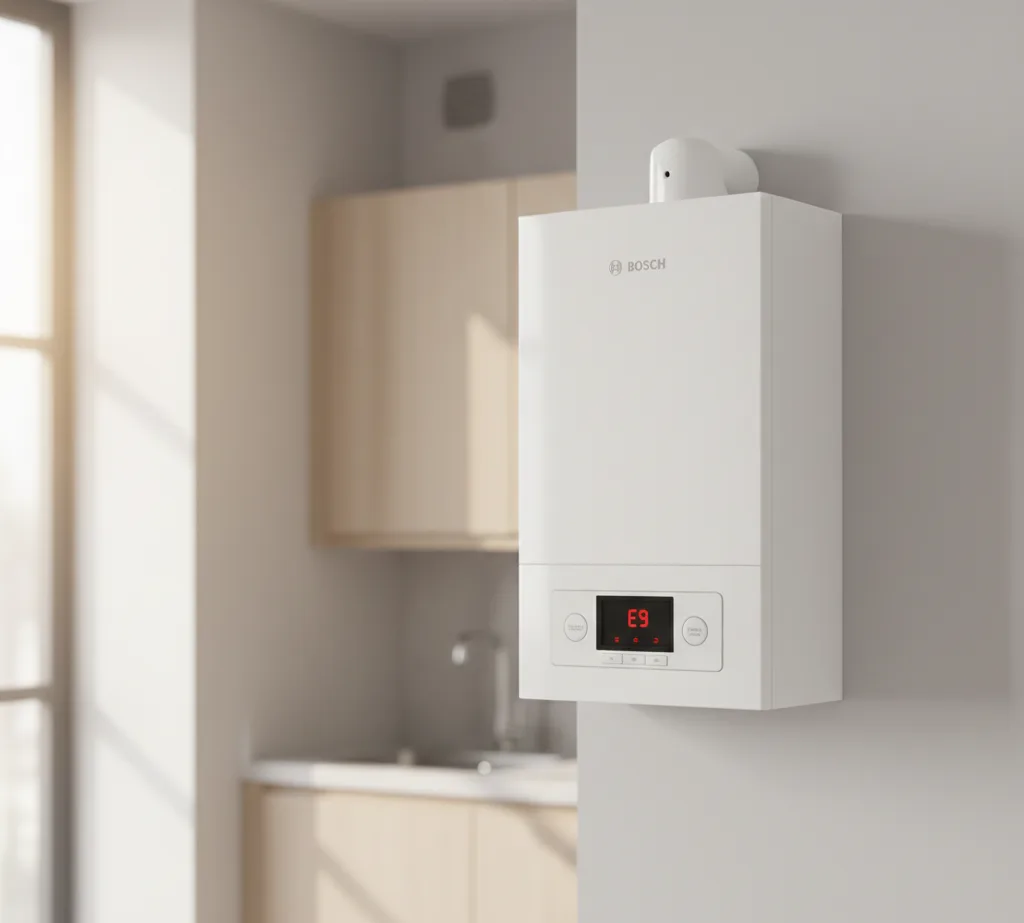
If your Worcester Bosch boiler is displaying E9, it means ignition has failed. The boiler tried to light the burner but couldn't establish a stable flame, so it's locked out for safety.
This is a common fault code, particularly during winter months. Here's what to check and when to call us.
Short on time?
The quickest and safest way to resolve an E9 fault is to speak to a qualified Gas Safe engineer. We're Worcester Bosch Accredited Installers covering North London, West London, Watford, Herts and Middx and nearby.
Key Takeaways
- E9 means ignition failure — the boiler tried to light but couldn't establish a flame, and has locked out for safety.
- Check your gas supply first — try your gas hob or another gas appliance. No gas supply is more common than you'd think.
- Frozen condensate pipe is the most common winter cause — pour warm (not boiling) water over the external pipe to thaw it.
- If you smell gas, leave immediately and call the National Gas Emergency line on 0800 111 999.
- We're Worcester Bosch Accredited Installers — we carry Worcester parts and usually resolve E9 faults on the same visit.
Quick Checks You Can Do
Check your gas supply
Try your gas hob or another gas appliance in your home. If nothing works, your gas supply may be interrupted. Contact your gas supplier to check for outages or payment issues.
Check the gas valve
Find the yellow isolation lever beneath or near your boiler on the gas pipe. It should be positioned in line with the pipe (open). If it's across the pipe, it's closed — simply turn it to open.
Frozen condensate pipe?
In cold weather, check the white plastic condensate pipe that runs outside. If frozen, it blocks the boiler from operating. Pour warm (not boiling) water over the external section several times until thawed.
Try resetting
Press the reset button once and hold for 3–5 seconds. Watch what happens. If E9 returns immediately after the boiler attempts to fire, you need an engineer to diagnose further.
Listen carefully
When the boiler tries to start, you should hear the fan spin up (a whirring sound) followed by clicking from the ignition electrode. No sounds at all indicates a component failure.
What Causes Worcester E9?
The E9 code indicates the boiler attempted ignition but failed to detect a flame. These are the most common causes:
No gas supply
More common than you'd expect. Smart meter glitches, prepayment issues, or local supply problems can all interrupt your gas. Always verify with other appliances first.
Frozen condensate pipe
Very common in winter. The condensate pipe carries acidic waste water outside. When temperatures drop, it freezes and blocks, preventing the boiler from firing.
Faulty ignition electrode
The electrode creates the spark that lights the gas. Over years of use, it wears down, cracks, or becomes coated with debris. A worn electrode produces weak or no spark.
Flame sensor problems
The flame sensing electrode detects whether the burner has successfully lit. If dirty or faulty, it can't confirm the flame presence, causing immediate lockout even when the burner actually lights.
Gas valve fault
Common on older Worcester boilers. The gas valve can stick partially closed, fail to open fully, or develop electrical faults. This restricts or stops gas flow to the burner.
Flue blockage
Bird nests, leaves, or debris blocking the flue terminal outside. Particularly common in spring and autumn. A blocked flue prevents safe combustion and triggers safety lockouts.
Fan failure
The fan must run before ignition to create proper airflow. If you don't hear whirring when the boiler starts its ignition sequence, the fan may have failed or be running too slowly.
Air pressure switch fault
This switch confirms the fan is running correctly before allowing ignition. If faulty, it can block ignition even when everything else works fine.
E9 vs EA — What's the Difference?
Both codes relate to ignition problems but indicate different failures:
- E9 means the flame never established at all during the ignition attempt
- EA means flame established initially but was then lost during operation
E9 typically points to spark, gas supply, or initial ignition issues. EA often indicates flame sensing problems or intermittent gas supply issues. Both require similar diagnostic approaches but can have slightly different root causes.
Can I Fix E9 Myself?
You can safely perform these checks without risk:
- Verify gas supply by testing other gas appliances
- Open the gas isolation valve if it's been closed
- Thaw a frozen condensate pipe using warm water
- Reset the boiler once to attempt clearing the fault
- Check the external flue terminal for obvious blockages
- Listen for fan and ignition sounds during startup
Don't open the boiler casing or attempt any work on gas components. This is illegal without Gas Safe registration and extremely dangerous. Internal repairs require a qualified engineer.
When to Call an Engineer
Contact us if you experience any of these situations:
- E9 returns immediately after reset
- No clicking sound when the boiler attempts to fire
- No fan noise (whirring) when the boiler starts up
- You see a brief flame visible through the sight glass then E9 appears
- Soot or black marks around the boiler or flue
- The condensate pipe freezes repeatedly despite thawing
- Any smell of gas (also call National Gas Emergency on 0800 111 999)
- Unusual noises during ignition attempts
Preventing E9
These measures significantly reduce your risk of E9 faults:
Annual service
Includes electrode cleaning, ignition system checks, and component inspection. Catches problems before they cause breakdowns. Book your annual boiler service.
Insulate condensate pipe
Wrap external sections with foam lagging before winter. This prevents the most common winter cause of E9.
Fit a flue guard
If birds nest near your flue terminal, a guard prevents blockages from nesting material.
Don't ignore warning signs
If your boiler is slow to ignite or makes unusual sounds, get it checked before it fails completely.
Frequently Asked Questions
Can I fix Worcester Bosch E9 myself?
You can check your gas supply, thaw a frozen condensate pipe, check the gas isolation valve is open, and try a single reset. Anything beyond that requires a Gas Safe registered engineer. Never open the boiler casing or work on gas components yourself.
How much does it cost to fix a Worcester Bosch E9 fault?
Costs depend on the cause. Electrode replacement is typically £80–£160. Gas valve replacement is more expensive at £200–£400. Frozen condensate pipes are often resolved at no cost if you thaw them yourself. At Advanced Heating & Plumbing, we always quote before we start. Get a quote.
Is E9 dangerous?
The E9 lockout itself is a safety feature — the boiler has shut down because it couldn't safely establish a flame. However, if you smell gas at any time, leave your property immediately and call 0800 111 999. Don't attempt to restart the boiler if you suspect a gas leak.
Why does E9 keep coming back after I reset?
A recurring E9 means the underlying cause hasn't been resolved. The most common persistent causes are a worn ignition electrode, failing gas valve, or a condensate pipe that keeps refreezing. Professional diagnosis is needed to identify and fix the root cause.
Which Worcester Bosch models show the E9 code?
E9 can appear on most Worcester Bosch boilers including the Greenstar i, Greenstar Si, Greenstar CDi, Greenstar Ri, Greenstar 4000, and Greenstar 8000 ranges. The diagnostic process is similar across all models.
Can't fix it yourself?
Our Gas Safe engineers repair gas, oil, and electric boilers same-day. No separate call-out fee. Diagnosis is charged at our labour rate, and we quote before we start.
Found this useful? Add Advanced Heating & Plumbing as a preferred source on Google Search and AI Overviews.